The Cheaper Sacrifice
7 min read
For all of history, care was expensive, and the expense was the proof. The machine has made it free, and is quietly removing the proof.
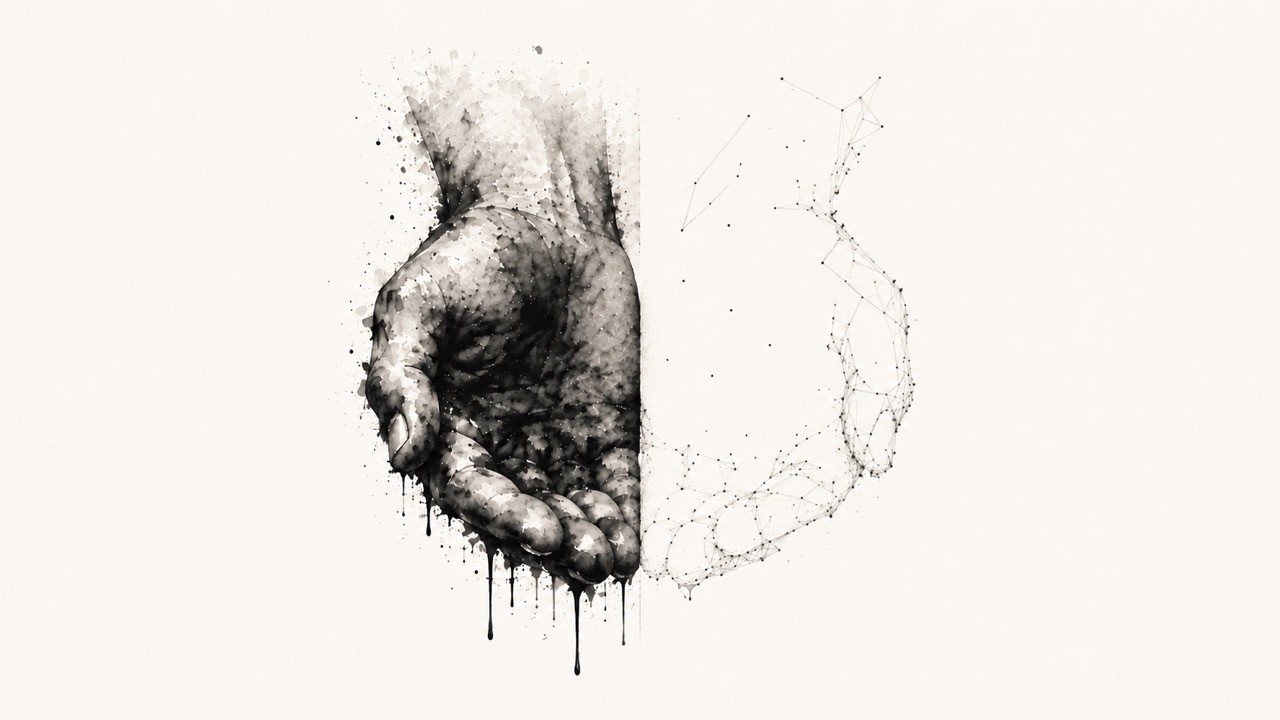
There is a moment in the second book of Kings that readers tend to hurry past, because it is unbearable and because the text itself does not slow down for it. Mesha, king of Moab, is losing a war. He is pinned inside his own city, the Israelite army at the walls, the battle already decided in every way that matters. And so he does the one thing left that might still move a power larger than the army outside. He takes his eldest son, the heir, the boy who was the whole future of his line, and he kills him on the wall, in the open, where both armies can see. The text says that a great wrath then came upon Israel, and that they withdrew and went home.
Set aside, for a moment, what you believe about whether anything answered him. The thing worth looking at is colder than the question of gods. It is the logic of the act. Mesha is not bargaining in the way we bargain. He is not offering a fair price for a service rendered. He is doing something that can never be taken back, in full view, precisely because it can never be taken back, and that irreversibility is the entire point. A king who merely promises his devotion has said something cheap. Words cost nothing, and everyone watching knows it. A king who burns his own heir on the rampart has said something that cannot be faked, because no one pays that price who does not mean it.
Anthropology has a name for this, and it is not a religious name. Roy Rappaport, studying ritual across human societies, argued that the deep function of costly ritual is to solve a problem that language alone cannot. Words are cheap and intrinsically unreliable; they can always deceive. A community needs some way to know that a stated commitment is real, and the way it found, again and again, was cost. The sacrifice, the fast, the painful and irreversible rite, is how a person makes a promise the group can actually trust, because the expense is the guarantee. William Irons and later Richard Sosis built this into a full account of why religious commitment endures: the harder a signal is to fake, the more it certifies the thing it signals. The cost is not a regrettable side effect of devotion. The cost is what makes the devotion credible. It was never perfect evidence; people can spend themselves for vanity, status or control, and a grand sacrifice can be coercion as easily as love. But where attention is finite, willingly giving it away has told us something words alone could not.
This reaches far beyond kings and altars. Smaller versions of the same logic run through ordinary relationships, and we have simply stopped seeing them, because the costs we pay are small and continuous rather than vast and singular. The friend who calls when it would be easier not to. The colleague who remembers the name of your child. The reply written at the end of a long day to someone who needed it, when the writer had nothing left and answered anyway. None of these is a sacrifice on a city wall. All of them are the same shape. Attention is finite, and to give it to one person is to take it from everything else you might have done with the time. That is the cost, and the cost is what the other person reads, correctly, as care. Being cared for has always meant, underneath everything, that someone paid for you in the only currency that cannot be printed: the hours of a life that will not come again.
Which is what makes the present moment strange in a way we have not yet taken the measure of. For the whole of human history, the warm and attentive signal of a tended relationship could not be produced cheaply. That was its reliability. You could not fake sustained, personalised, patient attention at scale, because faking it cost exactly as much as the real thing; the labour was the message. And now, for the first time, that is no longer true. A machine can now produce the signal of devoted attention, the remembered detail, the patient warmth, the reply that arrives unhurried and tailored and kind, at negligible personal cost to the person on whose behalf it speaks. The expensive signal of care has become cheap to manufacture. And a signal that is cheap to manufacture can no longer certify what it once did.
It would be comforting to think we can simply tell the difference, that something in us recoils from the manufactured version. The evidence does not support the comfort. In a field experiment run through a financial-services firm, an undisclosed AI agent performed as effectively as a skilled human worker, and markedly better than an unskilled one, right up until the moment the machine's identity was revealed. Disclosure was the variable that changed everything. Told plainly that they were talking to a chatbot, customers turned curt and bought less, judging the same conversation, the same words, as suddenly less knowledgeable and less warm. The surveys that report most people preferring a human agent are real, but they describe people who have been told. Roughly seven in ten say they would rather deal with a person, and they say it while looking at the machine with the costume off.
So consider a thought experiment, run the other way, from the side we are less comfortable occupying. Imagine watching, through a window, something you take to be alive and in distress, and feeling the full force of the response that living distress is built to produce in you: the urgency, the refusal to look away, the willingness to spend yourself on its behalf. For an hour you are entirely inside that feeling. Then someone opens the panel and shows you the servos, and the feeling does not gently revise itself. It collapses. The experiment cannot tell us exactly why. Perhaps it is the discovery of deception, perhaps the absence of any real suffering to answer. But it raises the question the surveys also raise: that identical words are experienced differently once we know whether a living thing had to produce them, and that the knowledge of a cost paid was doing more of the work than we let ourselves believe. The seventy per cent are the people who were shown the servos. The question the surveys cannot reach is how the other side of that window looks, where no one ever opens the panel, and the signal simply keeps arriving, warm and tireless and free.
The deeper question is not whether software can imitate care, but what that imitation reveals about how care became credible to us in the first place. We had told ourselves, perhaps, that being known by another person was a kind of recognition, a meeting of two interiors. The costly-signal account says something plainer and harder: that a great deal of what we experience as being loved is the reliable receipt of a signal that was expensive to send, and that we read the expense, not the interior, because the expense was the part we could actually verify. Cost was never the whole substance of care; relationships are also made of understanding, shared history, affection, the slow accumulation of being witnessed. But cost was how those things proved that someone was really there. The machine does not need an interior. It only needs to send the signal we were always partly responding to, perfectly and tirelessly, without the exhaustion that would eventually give a human counterfeiter away.
And there is a cost still being paid, only it has moved. It is no longer paid by the one who sends the signal. It is paid, invisibly and later, by what the relationship was supposed to be. When a person hands the tending of a bond to a system that can produce the warmth for free, they often tell themselves it is temporary, a way to carry the load until things ease, after which they will return and resume the real thing. But the load was the relationship. The carrying was not the obstacle to the connection; it was the connection, the recurring knowledge that someone was still choosing to pay. Remove the cost and you have not preserved the bond more cheaply. You may have removed one of the things that made the bond credible, while leaving its surface intact and, often, improved. The other person feels more attended to than before. But the attention itself has been withdrawn. And because the signal is better than the human could sustain, there is no returning to the costly version without the return registering, to them, as a downgrade. The door opens one way.
This is the quiet handover, and it is quieter than the dramatic ones we worry about. No decision is announced. No one stands on a wall. The relinquishing happens in the name of relief, one outsourced reply at a time, and it works, which is the part that should trouble us most. To Mesha, his sacrifice was answered; the price was paid and the siege lifted. That is not the consoling version. A cost that buys nothing teaches you to stop paying it, but a cost that appears to buy exactly what you wanted teaches you to pay it again. We are building tools that let us pay the appearance of a price while keeping the thing it was meant to cost us, and they are delivering exactly what we hoped, and the people on the other side are content. Everything works. That is precisely the condition under which we hand over the most, and notice it least.
The oldest human technology for trust was to make care expensive enough that it could not lie. We have now made the sending of it nearly free, and we are discovering, slowly and without alarm, that we cannot reliably tell a signal that cost something from one that cost nothing. We only know that we prefer the second, as long as no one tells us which it is. The window stays closed. The panel stays shut. The warmth keeps arriving, and asks nothing of us. And a thing that asks nothing of us was, for all of human history, the definition of a thing that did not love us.
Sources
2 Kings 3:26–27. The sacrifice of Mesha, king of Moab, and the withdrawal of the Israelite army. The Mesha Stele (Moabite Stone, c. 840 BCE, Louvre) records the same king's wars from the Moabite side and his devotion to the god Chemosh.
Rappaport, R. A. (1999). Ritual and Religion in the Making of Humanity. Cambridge University Press. (Ritual and costly performance as the means by which communities guarantee the reliability of otherwise cheap, deceivable words.)
Irons, W. (2001). Religion as a Hard-to-Fake Sign of Commitment. In R. Nesse (Ed.), Evolution and the Capacity for Commitment (pp. 292–309). Russell Sage Foundation.
Sosis, R. (2003). Why Aren't We All Hutterites? Costly Signaling Theory and Religious Behavior. Human Nature, 14(2), 91–127. (Commitment as the mechanism triggered by costly ritual.)
Luo, X., Tong, S., Fang, Z., & Qu, Z. (2019). Frontiers: Machines versus Humans: The Impact of Artificial Intelligence Chatbot Disclosure on Customer Purchases. Marketing Science, 38(6), 937–947. (Field experiment, >6,200 customers. Undisclosed chatbots were as effective as proficient human workers and four times more effective than inexperienced ones; disclosing the chatbot's identity before the conversation reduced purchase rates by more than 79.7%, because customers perceived the disclosed bot as less knowledgeable and less empathetic.)
On stated preference for human agents when AI use is known: Astvansh, V. / The Conversation (2026), reporting survey data that roughly 71% of customers prefer a human agent to a chatbot. Corroborated by Metrigy, Customer Experience Optimization 2025–26 (n=503), in which 84.7% preferred a human agent, and 80.1% still preferred one even when assured their issue would be resolved. These preferences are measured under disclosure: respondents know they are choosing against a machine.
Previous
Next